24 Sept 2026
Breast Reduction Recovery & Long-Term Results | Hyderabad
Recovery Questions 1. How Painful Is Breast Reduction Surgery? Some discomfort, tightness, swelling, and sensitivity are expected after breast reduction surgery. However, the level...
Recovery Questions
1. How Painful Is Breast Reduction Surgery?
Some discomfort, tightness, swelling, and sensitivity are expected after breast reduction surgery. However, the level of discomfort varies from patient to patient.
Most patients describe the early postoperative period as more of a feeling of tightness, soreness, or pressure rather than severe pain. Discomfort is generally most noticeable during the first few days and gradually improves as healing progresses.
I prescribe or recommend appropriate pain-relief medication based on your individual needs. Wearing the recommended supportive garment, getting adequate rest, and following postoperative instructions can also help make the recovery period more comfortable.
If you experience sudden or severe worsening pain, particularly when accompanied by significant swelling, redness, fever, or other concerning symptoms, you should contact your surgical team promptly.
2. How Long Is Recovery After Breast Reduction?
Recovery varies between patients, but most people can gradually return to normal daily activities over the course of several weeks.
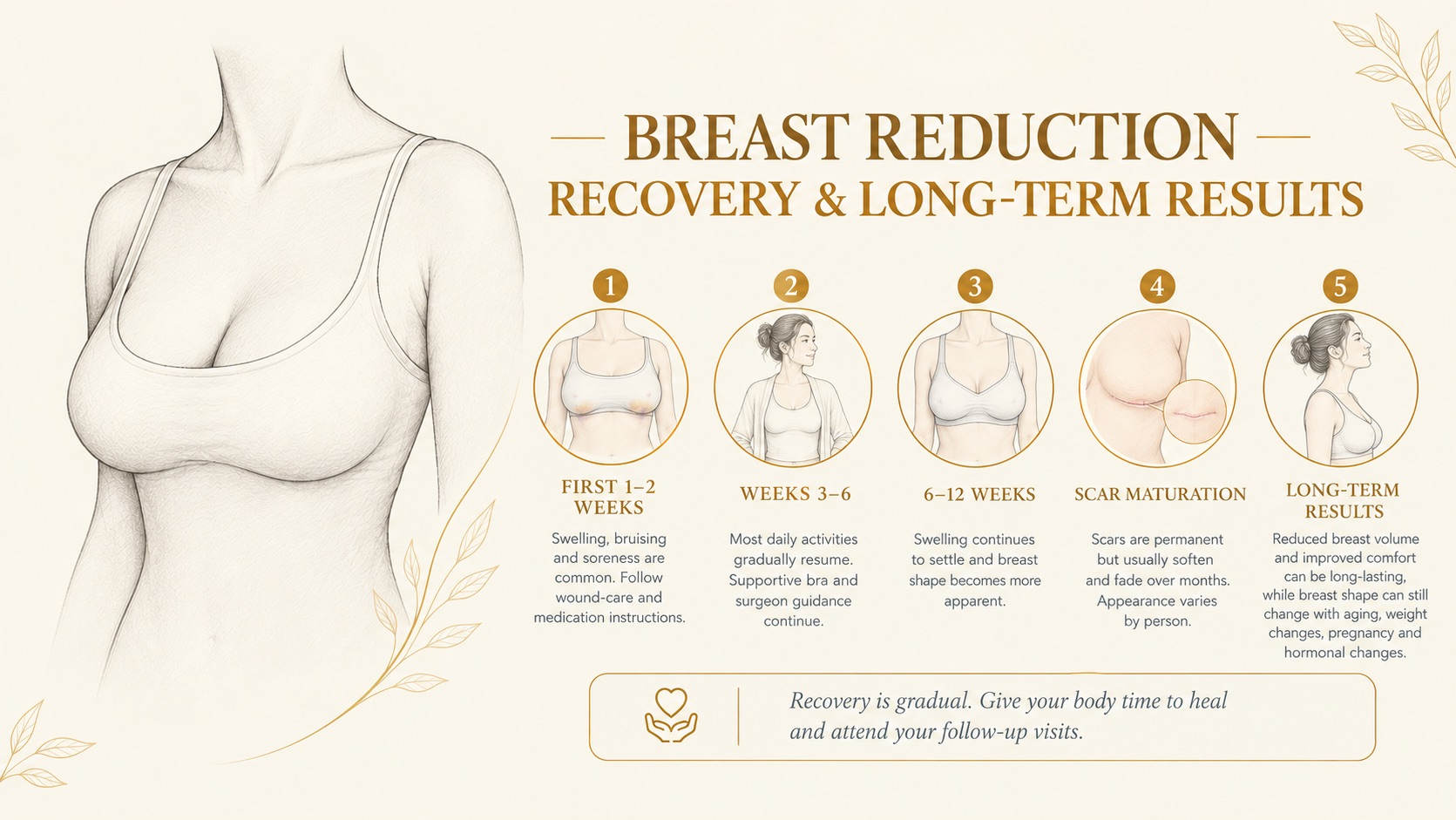
During the first week, you may experience swelling, bruising, tightness, and soreness. Light activities are usually encouraged, while strenuous activities and heavy lifting should be avoided.
Many patients feel significantly more comfortable within 2–3 weeks, although complete healing continues for several months. The appearance of the breasts will also continue to change as swelling decreases and the tissues settle. Scars can take many months or longer to mature and fade.
I provide individualized postoperative instructions and monitor your healing during follow-up appointments.
3. When Can I Return to Work After Breast Reduction?
The timing of your return to work depends on your type of work, your recovery, and how your body is healing.
Patients with desk-based or relatively light jobs may often return to work within approximately 1–2 weeks, provided they are comfortable and their surgeon is satisfied with their recovery.
If your work involves:
• Heavy lifting
• Frequent bending or pushing
• Physical labor
• Repetitive upper-body movements
• Prolonged or strenuous activity
you may need additional time before returning to your normal duties.
I will assess your healing during follow-up and advise you when it is appropriate to resume your specific work activities.
4. When Can I Exercise Again After Breast Reduction?
Light movement and short walks are generally encouraged during the early recovery period to support mobility. However, strenuous exercise and activities that place stress on the breasts should be avoided initially.
As healing progresses, activities can usually be introduced gradually. Many patients can begin returning to more routine exercise after several weeks, but the exact timing depends on the type of activity and individual healing.
Activities such as running, weightlifting, chest exercises, and high-impact workouts may require a longer period before they can be resumed safely.
I will provide specific guidance based on your recovery and may recommend gradually increasing your activity rather than returning immediately to your previous exercise routine.
5. What Bra Should I Wear After Breast Reduction?
After breast reduction surgery, I generally recommend a comfortable, supportive postoperative or surgical bra according to your individual needs.
The ideal bra should:
• Provide gentle, comfortable support
• Avoid excessive pressure on the surgical sites
• Have soft, breathable material
• Be easy to put on and remove
• Avoid underwires while the incisions are healing, unless specifically advised otherwise
Your breast size and swelling will change during the early recovery period, so it is usually best to avoid purchasing multiple expensive bras immediately after surgery.
I will advise you on the appropriate type of support garment and when you can transition to your regular bras.
6. When Will Swelling Settle Completely?
Swelling is a normal part of the healing process after breast reduction surgery. It is usually most noticeable during the first few weeks and gradually decreases over time.
You may notice that one breast appears more swollen than the other during the early healing period. Mild asymmetry can occur temporarily as each side heals at a different rate.
Although much of the swelling improves within the first several weeks, the breasts may continue to change in shape, size, softness, and position for several months.
Final breast shape and scar maturation take time, and the exact timeline varies between patients.
I monitor your progress during follow-up appointments and can advise you if swelling appears unusual or is accompanied by symptoms such as increasing pain, redness, fever, or sudden changes in breast size.
Long-Term Outcome Questions
7. Will I Be Able to Breastfeed After Breast Reduction Surgery?
Breastfeeding after breast reduction may be possible for some women, but it cannot be guaranteed.
The ability to breastfeed depends on several factors, including the surgical technique, how much breast tissue is removed, and whether the milk-producing glands and ducts remain connected to the nipple.
During breast reduction, I use techniques designed to preserve the nipple's blood supply and, where appropriate, maintain the connection between the nipple and underlying breast tissue. However, some patients may experience a reduced milk supply or may not be able to breastfeed exclusively after surgery.
If you are planning to have children in the future, I discuss your plans during the consultation and take them into consideration when selecting the appropriate surgical technique.
8. Will Nipple Sensation Change After Breast Reduction?
A change in nipple or breast sensation can occur after breast reduction surgery.
Some patients experience temporary numbness, increased sensitivity, tingling, or altered sensation during the healing process. In many cases, sensation gradually improves as the nerves recover.
However, sensation can sometimes remain different from before surgery. Rarely, there may be a more significant or permanent change in nipple sensation.
The likelihood of sensation changes depends on factors such as the surgical technique, the amount of tissue removed, breast size, and individual healing.
I discuss these potential changes with you before surgery so that you have a clear understanding of the possible outcomes.
9. Can the Breasts Grow Back After Breast Reduction?
Breast reduction permanently removes a portion of the breast tissue, so the breasts do not typically "grow back" in the same way as before surgery.
However, the remaining breast tissue can change over time. Weight gain, hormonal changes, pregnancy, breastfeeding, and aging can increase breast volume or alter breast shape.
In some patients, significant changes may make the breasts appear larger again. This does not necessarily mean that the removed tissue has grown back.
Maintaining a relatively stable and healthy weight can help support the longevity of your results.
10. Will Weight Gain Affect My Breast Reduction Results?
Yes. Significant weight gain can affect the size and shape of your breasts after reduction surgery.
Although some breast tissue has been permanently removed, the remaining breast tissue can increase in volume with weight gain, particularly when it contains a significant amount of fatty tissue.
Weight fluctuations can also affect the skin and overall breast shape. Significant weight loss may similarly change breast volume and potentially result in additional skin laxity.
For this reason, I generally recommend reaching a stable, healthy weight before surgery whenever possible and maintaining that weight afterward.
11. How Long Do the Results of Breast Reduction Last?
Breast reduction provides a long-lasting reduction in breast size, because the tissue removed during surgery does not grow back.
However, the breasts naturally change throughout life. Aging, pregnancy, breastfeeding, weight fluctuations, hormonal changes, and changes in skin elasticity can affect breast size, shape, and position over time.
Maintaining a stable weight, following a healthy lifestyle, and wearing appropriate support during physical activity can help maintain your results.
While it is not possible to stop the natural aging process, many patients can enjoy the benefits of breast reduction for many years.
12. Will My Breasts Look Natural After Breast Reduction?
The goal of breast reduction is not only to make the breasts smaller but also to create a balanced and proportionate breast shape that suits your body.
During surgery, excess tissue and skin are removed and the remaining breast tissue is reshaped. The nipple and areola are also repositioned when necessary to create a more proportionate appearance.
The final appearance depends on factors such as:
• Your original breast size and shape
• Skin quality and elasticity
• Amount of tissue removed
• Breast and chest proportions
• Surgical technique
• Individual healing
It is normal for the breasts to look swollen or feel firm immediately after surgery. Their shape and appearance gradually change as swelling decreases and the tissues settle.
While I aim for a natural and proportionate result, individual healing and breast anatomy mean that results can vary between patients.
13. Can Breast Asymmetry Be Corrected With Breast Reduction?
Yes. Breast reduction can often improve breast asymmetry, although perfect symmetry cannot always be achieved.
It is very common for women to have some natural difference between their breasts in terms of:
• Size
• Shape
• Position
• Nipple and areola location
• Amount of breast tissue
• Skin elasticity
During breast reduction, I can adjust the amount of tissue removed from each breast and modify the shape or position to improve the overall balance.
However, some asymmetry may remain after surgery, and differences can also develop during the healing process or change over time.
During your consultation, I assess your existing asymmetry and explain what degree of improvement may realistically be achieved while prioritizing a safe and proportionate result.
Continue Reading: The Complete Breast Reduction Guide
• Part 1: Thinking About Breast Reduction? 8 Questions to Ask Before Surgery → /breast-reduction-candidate-hyderabad
• Part 2: How Is Breast Reduction Surgery Performed? 7 Questions About the Procedure → /breast-reduction-procedure-scars-hyderabad
• Part 3: Breast Reduction Recovery and Results: 13 Questions Answered by a Plastic Surgeon (you are here)
• Part 4: Breast Reduction Risks, Cost and Insurance: 14 Honest Answers From a Plastic Surgeon → /breast-reduction-cost-risks-hyderabad