24 Sept 2026
Breast Reduction Procedure, Scars & Surgery Time | Hyderabad
Procedure-Related Questions 1. How Is Breast Reduction Surgery Performed? Breast reduction surgery, also known as reduction mammoplasty, involves removing excess breast tissue, fat...
Procedure-Related Questions
1. How Is Breast Reduction Surgery Performed?
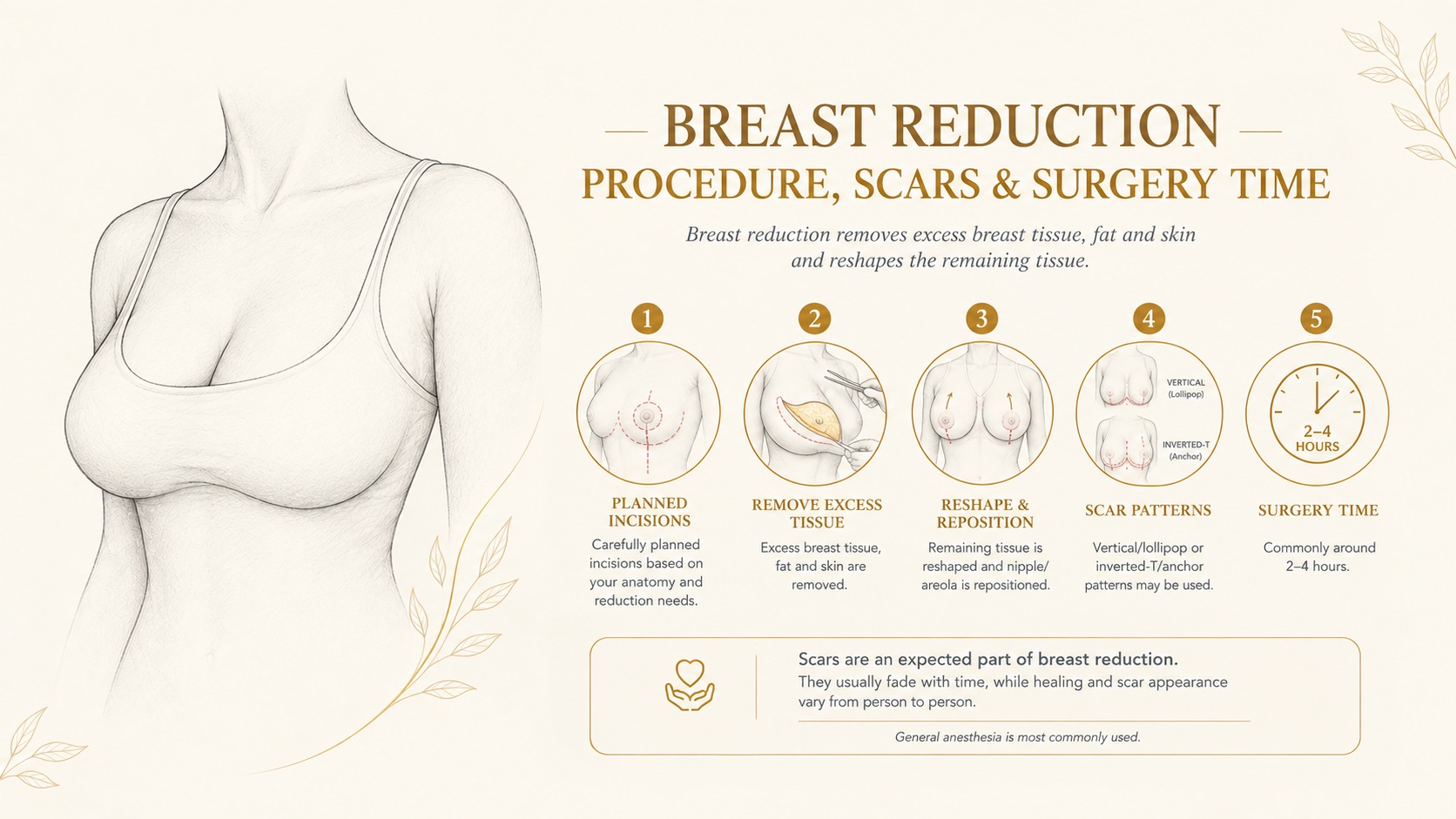
Breast reduction surgery, also known as reduction mammoplasty, involves removing excess breast tissue, fat, and skin to reduce the size and weight of the breasts. The remaining breast tissue is then reshaped to create a more balanced breast contour.
The surgical technique depends on your breast size, shape, amount of excess skin, nipple position, and the degree of reduction required.
Commonly, the procedure involves:
1. Making carefully planned incisions on the breast.
2. Removing excess breast tissue, fat, and skin.
3. Reshaping the remaining breast tissue.
4. Repositioning the nipple and areola to a more appropriate position while maintaining their blood supply whenever possible.
5. Closing the incisions to create the new breast shape.
In some patients, liposuction may also be used as an additional technique, particularly to improve fullness around the sides of the breast.
During your consultation, I select the surgical approach based on your individual anatomy, desired outcome, and safety considerations.
2. What Scars Will I Have After Breast Reduction?
Breast reduction requires incisions, so scarring is an expected part of the procedure. The location and length of the scars depend on the surgical technique and the amount of reduction required.
Common incision patterns include:
• Vertical or "lollipop" incision: Around the areola and vertically down toward the breast crease.
• Inverted-T or "anchor" incision: Around the areola, vertically down the breast, and along the breast crease.
• Other techniques: May be appropriate for selected patients depending on breast size, shape, and the amount of tissue that needs to be removed.
I place the incisions as carefully as possible and close them using techniques intended to support good healing. Over time, scars generally fade and become less noticeable, although they do not disappear completely.
Scar appearance varies between individuals and can be influenced by genetics, skin type, wound healing, smoking, sun exposure, and postoperative care.
During your consultation, I can explain which incision pattern is most appropriate for your breasts and what type of scarring you can realistically expect.
3. Where Will the Nipple Be Positioned?
During breast reduction, the nipple and areola are generally repositioned to a more elevated and proportionate position on the reshaped breast.
The appropriate position depends on your:
• Breast size and shape
• Degree of breast drooping
• Nipple position before surgery
• Amount of tissue being removed
• Chest and body proportions
• Surgical technique
Whenever possible, the nipple and areola remain attached to underlying breast tissue so that their blood supply and nerve connections can be maintained.
In cases involving very large or significantly drooping breasts, a different surgical approach may sometimes be necessary. I discuss the appropriate technique with you during your consultation based on your individual anatomy.
The goal is to achieve a natural-looking breast contour and proportionate nipple position while prioritizing safety.
4. How Long Does Breast Reduction Surgery Take?
Breast reduction surgery commonly takes approximately 2 to 4 hours, although the exact operating time varies from patient to patient.
The duration can depend on factors such as:
• The amount of breast tissue being removed
• Breast size and shape
• The surgical technique used
• Whether additional procedures are performed
• Individual anatomy and surgical considerations
Before surgery, I will explain the expected procedure and approximate operating time based on your specific treatment plan.
The total time spent at the hospital or surgical facility will be longer than the operating time because you will also need time for preoperative preparation, anesthesia, and postoperative recovery.
5. What Type of Anesthesia Is Used for Breast Reduction?
Breast reduction surgery is most commonly performed under general anesthesia, meaning you will be asleep and comfortable throughout the procedure.
Before surgery, an anesthesiologist will review your medical history, medications, allergies, previous experiences with anesthesia, and overall health to develop an appropriate anesthesia plan.
Your anesthesia team will continuously monitor important parameters such as heart rate, blood pressure, oxygen levels, and breathing throughout the procedure.
The type of anesthesia and anesthesia plan will be discussed with you before surgery and may be adjusted according to your individual medical needs.
6. Can Liposuction Alone Reduce Breast Size?
In selected patients, liposuction can reduce breast volume, particularly when the breasts contain a significant proportion of fatty tissue. However, liposuction alone is not suitable for everyone.
Liposuction does not remove significant amounts of glandular breast tissue or excess skin. Therefore, it may not adequately address breasts that are very large, heavy, or significantly drooping.
Liposuction may be considered when:
• Breast volume is primarily related to fatty tissue
• There is relatively good skin elasticity
• Significant breast lifting is not required
• A modest reduction in volume is desired
• Additional contouring around the sides of the breasts is beneficial
Traditional breast reduction may be more appropriate when there is significant excess breast tissue, skin, or breast drooping.
During a consultation, I evaluate your breast composition, skin quality, shape, and goals to determine whether liposuction alone, surgical breast reduction, or a combination of techniques is appropriate.
7. How Much Breast Tissue Can Be Removed Safely?
There is no single amount of breast tissue that can be safely removed from every patient. The appropriate amount depends on your individual anatomy, breast size, tissue composition, blood supply, skin quality, overall health, and desired outcome.
During breast reduction, my priority is to achieve an appropriate reduction while maintaining adequate blood supply and tissue viability, particularly around the nipple and areola.
The amount removed may also be influenced by:
• Your starting breast size
• Breast shape and degree of drooping
• Chest and body proportions
• Amount of excess skin
• Nipple position
• Your desired breast size
• The surgical technique being used
In some cases, removing an extremely large amount of tissue may increase the risk of complications. Therefore, I determine the appropriate extent of reduction based on safety as well as your aesthetic and functional goals.
Rather than promising a particular weight or cup-size reduction, I discuss the amount of tissue that can reasonably be removed while aiming for a safe and proportionate result.
Continue Reading: The Complete Breast Reduction Guide
• Part 1: Thinking About Breast Reduction? 8 Questions to Ask Before Surgery → /breast-reduction-candidate-hyderabad
• Part 2: How Is Breast Reduction Surgery Performed? 7 Questions About the Procedure (you are here)
• Part 3: Breast Reduction Recovery and Results: 13 Questions Answered by a Plastic Surgeon → /breast-reduction-recovery-results-hyderabad
• Part 4: Breast Reduction Risks, Cost and Insurance: 14 Honest Answers From a Plastic Surgeon → /breast-reduction-cost-risks-hyderabad