12 Aug 2026
What Is Delayed Breast Reconstruction? A Surgeon Explains
Delayed Breast Reconstruction: It's Not Too Late There's a quiet assumption floating around that breast reconstruction is something you either do at the time of your mastectomy or...
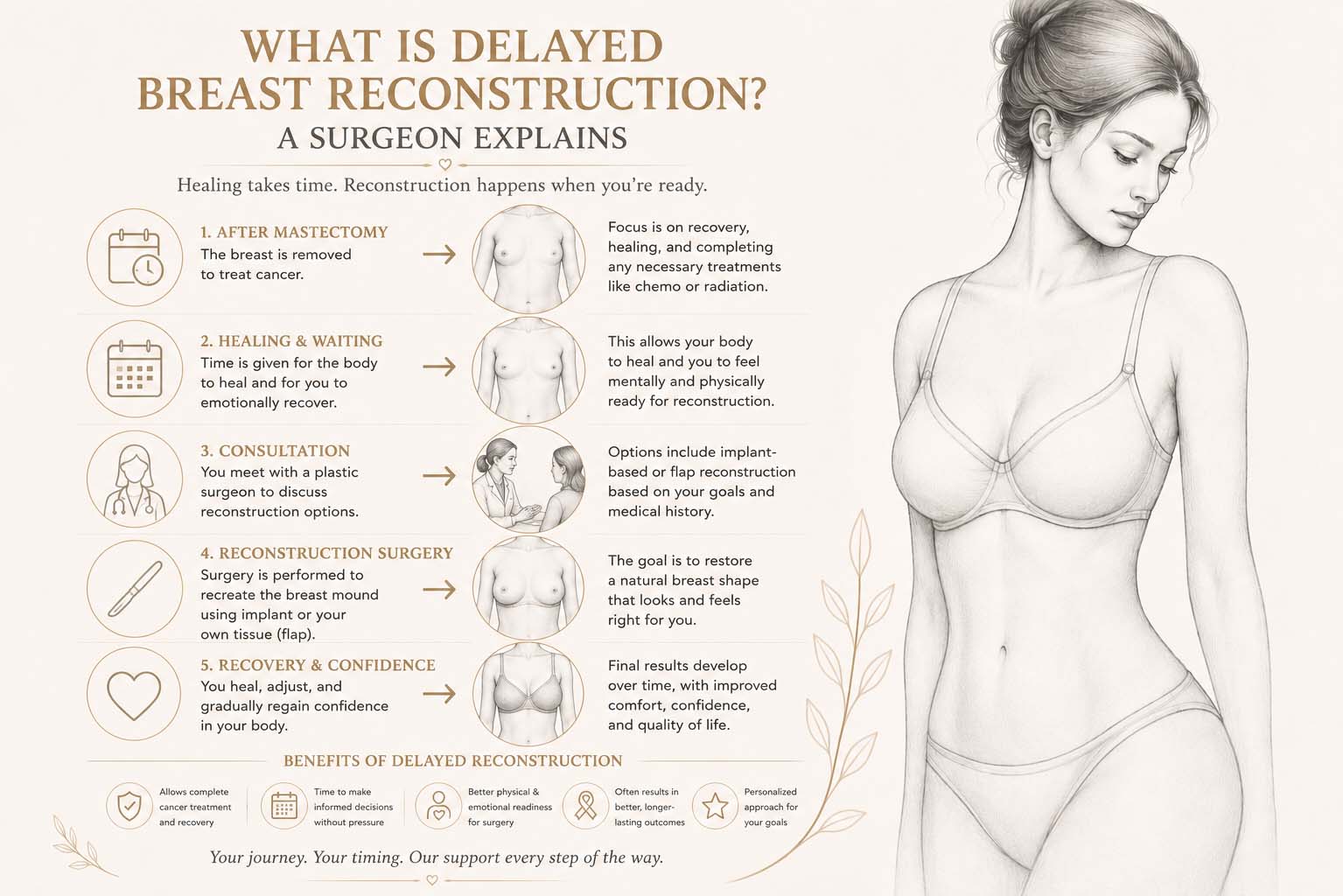
Delayed Breast Reconstruction: It's Not Too Late
There's a quiet assumption floating around that breast reconstruction is something you either do at the time of your mastectomy or miss out on forever. Women tell me this all the time — usually years later, usually a little apologetically, as though they've turned up too late for something.
They haven't. There is no expiry date on this.
Delayed breast reconstruction is reconstruction performed as a separate operation, months or years after the mastectomy has healed. I have operated on women six months after mastectomy and on women fifteen years after. Both were reasonable. Both went well.
What it actually means
In immediate reconstruction, the breast surgeon removes the breast and the plastic surgeon rebuilds it in the same anaesthetic. You wake up with a breast mound already in place.
In delayed reconstruction, the mastectomy is completed and allowed to heal. The chest becomes a flat, healed scar. Sometime later — after chemotherapy, after radiotherapy, after you've simply had enough time to breathe — reconstruction is planned as its own operation with its own recovery.
There's also a middle path, sometimes called delayed-immediate reconstruction, where a tissue expander is placed at the time of mastectomy purely to preserve the skin envelope. The definitive reconstruction happens later, once the oncology picture is clear.
Why women end up here
Sometimes it's a medical decision. Sometimes it's entirely personal. Both are valid.
Radiotherapy was planned or likely. This is the most common medical reason. Radiation is hard on reconstructed tissue — it tightens skin, raises the risk of capsular contracture around implants, and can compromise a flap result. Many surgeons, myself included, prefer to complete radiotherapy first and reconstruct afterwards, when the tissues have settled.
The cancer needed all the attention. When a diagnosis is advanced or urgent, reconstruction is a distraction the surgical team doesn't need and the patient can't process. Removing the cancer safely comes first. Everything else can wait.
You weren't ready to decide. This is a legitimate reason and I wish more women felt permitted to say it out loud. Being asked to choose between implants and flaps two weeks after a cancer diagnosis is an unfair ask. Some women want to finish treatment, get their strength back, and think about it when their head is clear.
Health had to improve first. Uncontrolled diabetes, smoking, significant weight issues, or other medical conditions may make immediate reconstruction unwise. Delaying gives time to optimise.
Circumstances changed. Many women simply live without reconstruction for years — often quite happily — and then something shifts. A prosthesis becomes uncomfortable, or tiring to manage. Shoulder and back pain develop from asymmetry. Or one day they decide they want it. That is reason enough.
The honest trade-offs
Delayed reconstruction has real advantages, and some genuine drawbacks. You should know both.
In its favour:
You make the decision without a cancer diagnosis pressing on you. You've seen how your body responded to treatment. Your oncology plan is complete, so the reconstruction can be designed around the final situation rather than a predicted one. And if radiotherapy was needed, the reconstruction is planned for radiated tissue from the outset, rather than being damaged by it afterwards.
Against it:
The skin envelope is gone. In immediate reconstruction, the natural breast skin is preserved and the result often has a more natural shape and better-hidden scars. In delayed reconstruction, that skin has been removed and the remaining tissue has contracted onto the chest wall. Rebuilding requires bringing in new skin — which is one reason flap reconstruction is often the better choice in delayed cases.
You also go through two separate operations and two separate recoveries. And you live with asymmetry in the interim, which some women find manageable and others find difficult.
What the surgery usually involves
For most delayed reconstructions, autologous (flap) reconstruction is the stronger option, particularly after radiotherapy. A DIEP flap uses skin, fat and blood vessels from the lower abdomen, moved to the chest and connected under a microscope. It brings its own healthy skin and blood supply — precisely what the radiated, contracted chest is short of. Latissimus dorsi, TUG and other flaps are alternatives depending on your body.
Implant-based reconstruction is still possible in delayed cases, usually with a tissue expander first. The expander is placed under the remaining skin and muscle and inflated gradually over several weeks, stretching the tissue until there's room for a permanent implant. This works well in non-radiated chests with good-quality skin. In radiated tissue, expansion is slower, more uncomfortable and less reliable.
Which route suits you depends on your radiotherapy history, your body shape, your other breast, previous abdominal surgery, and how much surgery you're prepared to go through. This is genuinely a conversation, not a menu.
Roughly what to expect
Consultation and planning takes a few visits. Photographs, measurements, examination of the chest and donor sites, and a frank discussion about what's realistic for your body.
Surgery ranges from around two hours for expander placement to six to ten hours for a microsurgical flap.
Hospital stay is one to two days for implant-based work, four to six days for a flap.
Recovery is three to four weeks for implant-based reconstruction, six to eight weeks for flap surgery.
Refinement almost always follows — a smaller procedure at three to six months to adjust symmetry, add fat grafting where contour needs improving, and if you want it, reconstruct the nipple. Nipple tattooing comes last.
The whole journey typically runs six to twelve months from first consultation to final result. It's worth knowing that upfront so the timeline doesn't feel like something has gone wrong.
Is there a point where it's too late?
No. There isn't a surgical deadline.
What matters is not how long it's been, but the quality of the tissue we're working with, your general health, and whether you're through active cancer treatment. A woman fifteen years post-mastectomy with healthy tissue and good general health is often an easier case than someone two years out with poorly healed radiated skin
The only real requirement is that you're doing it because you want to. Reconstruction isn't obligatory. Plenty of women live comfortably with a prosthesis, or with nothing at all, and that's a perfectly good outcome too. The point is that the choice stays open to you.
Come and talk about it
If you had a mastectomy some time ago and have started wondering about reconstruction, the consultation costs you nothing but an afternoon. Bring your surgical and oncology records if you have them — particularly details of any radiotherapy — and bring someone with you if that helps.
Dr. Divya Sai Narsingam Plastic & Reconstructive Surgeon Banjara Hills, Hyderabad
Frequently Asked Questions
How many years after a mastectomy can I have reconstruction?
There's no upper limit. Reconstruction has been performed successfully decades after mastectomy. Tissue quality, general health and completion of cancer treatment matter far more than elapsed time.
Is delayed reconstruction more difficult than immediate?
Technically, often yes — the original breast skin is gone and the tissue has contracted, so new skin usually has to be brought in. This is why flap reconstruction is frequently preferred in delayed cases. The results, however, can be excellent.
Will I need radiotherapy again before reconstruction?
No. Reconstruction doesn't require further radiotherapy. If you've already had it, that history shapes which reconstruction method we recommend, but it doesn't rule reconstruction out.
Does delayed reconstruction interfere with cancer surveillance?
No. Reconstruction after mastectomy doesn't hide recurrence, which typically appears in the skin or chest wall where it remains visible and examinable. Your oncology follow-up continues unchanged.
Is delayed breast reconstruction covered by insurance in India?
Most policies cover reconstruction after cancer surgery as a reconstructive rather than cosmetic procedure, including delayed cases. Terms vary between insurers, so it's worth confirming with your provider before scheduling.