12 Aug 2026
Skin Graft Complications — Causes, Warning Signs & How to Avoid Them
Why Skin Grafts Fail — and What You Can Do About It A skin graft is a strange kind of operation. The surgery itself might take under an hour. The outcome, though, isn't decided in...
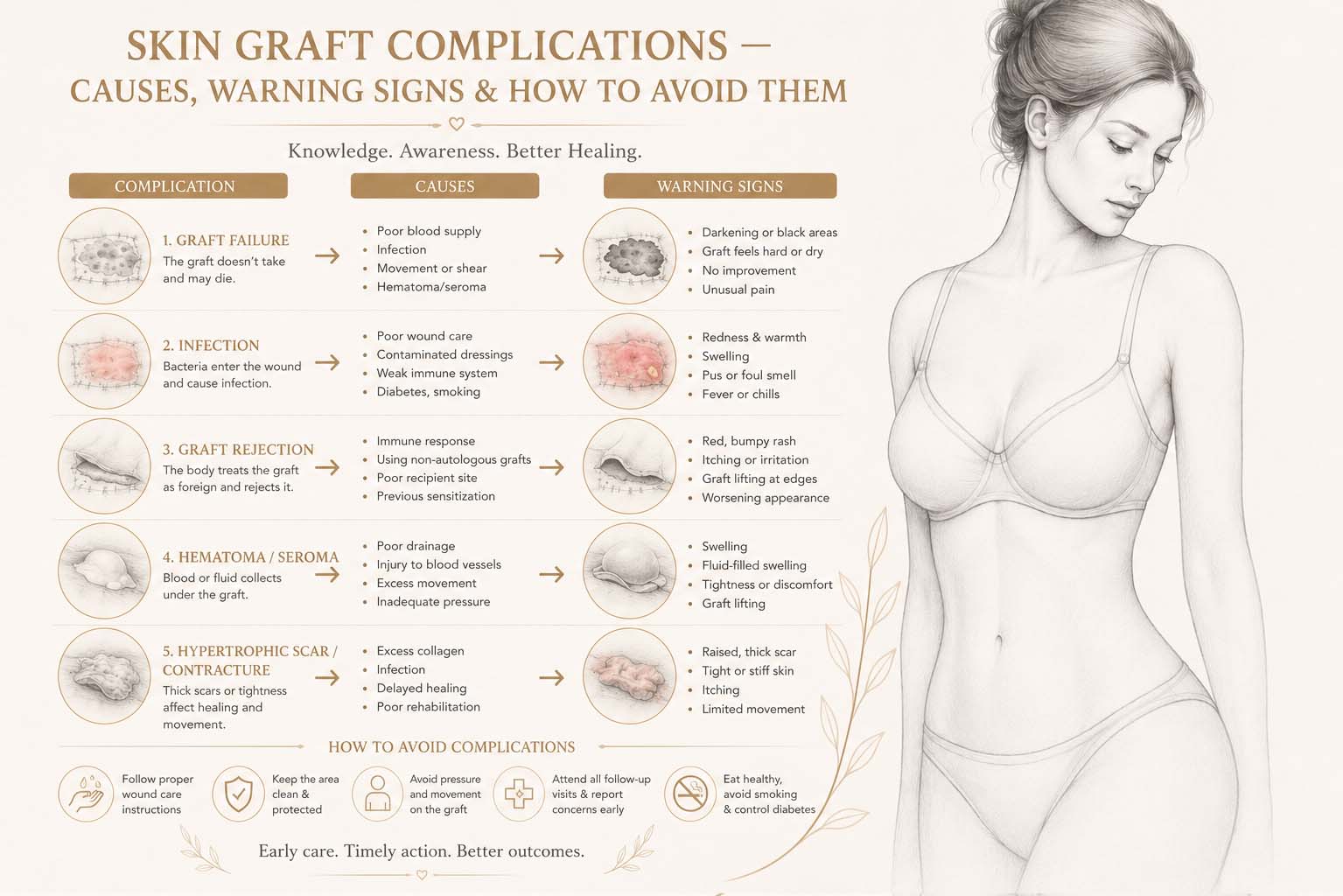
Why Skin Grafts Fail — and What You Can Do
About It
A skin graft is a strange kind of operation. The surgery itself might take under an hour. The outcome, though, isn't decided in that hour — it's decided over the following five days, largely by things that happen after you leave the theatre.
I explain it to patients this way: a graft is a piece of skin that's been separated from its blood supply and asked to survive on nothing until a new one grows into it. That takes about 72 to 96 hours. Everything we do — the dressing, the pressure, the instruction not to move that limb — exists to protect those few days.
Get them right, and grafts take beautifully. Get them wrong, and even technically perfect surgery fails.
The five things that actually go wrong
● Bleeding underneath the graft (haematoma)
This is the single most common reason a graft fails. Blood collects between the graft and the wound bed, physically lifting the graft away from the tissue it needs to connect with. The graft can't reach its new blood supply, and it dies.
How we prevent it: into the graft (meshing or "pie-crusting") so any fluid can escape, and a firm tie-over dressing that holds everything in contact. If you're on blood thinners, aspirin, or supplements like fish oil, vitamin E, garlic tablets or ginkgo, tell us well before surgery. Several of these need stopping in advance.
● Fluid collection (seroma)
Same problem, different fluid. Clear tissue fluid gathers under the graft and separates it from the bed. Meshing the graft largely solves this by giving the fluid somewhere to drain. Skin Graft Complications — Causes, Warning Signs & How to Avoid Them Dr. Divya Sai Narsingam, plastic surgeon in Banjara Hills, Hyderabad, meticulous control of bleeding before the graft goes down, small slits cut
● Movement (shear)
Even small, repeated movement rubs the graft against the wound bed and tears the delicate new capillaries as they form. This is why we splint joints, why we ask you to keep a grafted leg elevated, and why "just walking to the bathroom a few times" genuinely matters in the first week. Shear is the complication most within a patient's own control — and the one most often underestimated.
● Infection
A wound bed with a heavy bacterial load will not accept a graft. Streptococcal infection in particular can dissolve a graft within a day. This is why we're careful about the timing of grafting on chronic wounds, and sometimes swab and treat the wound first rather than grafting straight away.
● A wound bed that was never going to work
Grafts need a bed with a blood supply. Exposed bone without periosteum, bare tendon without paratenon, exposed cartilage, heavily irradiated tissue or dead tissue will not support a graft, no matter how well it's placed. These situations need a flap instead — tissue that brings its own blood supply with it.
The things that quietly raise your risk
Some risk factors sit in the background, and they matter more than most people expect.
Smoking is the biggest one. Nicotine constricts small blood vessels — exactly the vessels a graft depends on. Smokers have significantly higher graft failure rates. Stopping four weeks before surgery and staying off for at least two weeks after makes a measurable difference. This includes vaping and nicotine gum.
Uncontrolled diabetes impairs healing and raises infection risk. If your HbA1c is high, delaying elective surgery to bring it down is not a delay — it's part of the treatment.
Poor nutrition matters more than people think. Grafts need protein, vitamin C and zinc to heal. Patients who've been unwell, elderly patients, or those recovering from major illness often need nutritional support before grafting.
Poor circulation in the legs, from peripheral vascular disease or long-standing venous disease, needs assessing and often treating first. Grafting onto a leg with untreated venous hypertension frequently fails.
Steroids and immunosuppressants slow healing. We don't always stop them, but we plan around them.
What good aftercare looks like
Most of what determines your result is what happens in your own home. Here's what actually helps.
Keep the dressing dry and undisturbed. The first dressing usually stays on for five to seven days. Resist the urge to peek. Lifting a dressing early is one of the more common causes of avoidable graft loss.
Elevate, properly. For a leg graft, that means the foot above the level of your heart, not propped on a footstool. Most of the day. For the first week or two. This is inconvenient and it's the single most useful thing you can do.
Don't move the area. If a joint has been splinted, leave the splint alone. If you've been told bed rest, that's not a suggestion — it's the treatment.
Look after the donor site too. The donor area — usually the thigh — is often more painful than the graft itself, because it's a partial-thickness wound with exposed nerve endings. It typically heals in two to three weeks. Keep it clean and dressed as instructed.
Once healed, moisturise relentlessly. Grafted skin has no oil glands. It stays dry and itchy for months. Twice-daily bland moisturiser, gentle massage once the graft is stable, and pressure garments or silicone if scarring is a concern.
Protect from sun for at least a year. Grafted skin pigments unpredictably and permanently. Sunscreen or cover it.
Warning signs — call us, don't wait
Contact your surgeon if you notice:
● Increasing pain after day three, rather than settling pain
● Fever or chills
● Foul smell, or discharge soaking through the dressing
● Spreading redness beyond the dressing edge
● The dressing becoming loose, wet or slipping
● Any sudden, obvious bleeding
Early problems are often fixable. Late ones frequently aren't. If something feels wrong, ring — nobody minds a phone call that turns out to be nothing.
What "success" honestly looks like
A graft that takes fully is a good result — but it will never look like the skin around it. Grafted skin is usually a different colour, slightly different texture, and often thinner. Full-thickness grafts, taken from areas like behind the ear or the groin, match better and contract less, which is why we prefer them on the face and hands. Split-thickness grafts cover larger areas but contract more and look less like native skin.
Colour and texture keep improving for twelve to eighteen months. Judging your result at six weeks is judging it far too early. I ask patients to be patient with their own skin — it settles far more than they expect.
Getting the best possible outcome
The pattern in my practice in Banjara Hills, Hyderabad, is fairly consistent: the patients with the best results are the ones who prepared before surgery and followed instructions closely afterwards. Not the youngest, not the fittest — the most prepared.
If you're scheduled for a skin graft, or you've had one that hasn't healed the way you hoped, come in and let's look at it properly.
Dr. Divya Sai Narsingam Plastic & Reconstructive Surgeon Banjara Hills, Hyderabad
Frequently Asked Questions
How long does a skin graft take to heal?
The graft attaches to its new blood supply within about five to seven days. Surface healing takes two to three weeks. Colour, texture and softness continue improving for twelve to eighteen months.
Is the donor site more painful than the graft?
Very often, yes. Split-thickness donor sites are shallow wounds with exposed nerve endings, and patients frequently describe them as the more uncomfortable of the two. They usually settle within two to three weeks.
What happens if my skin graft fails?
Partial failure is common and often heals on its own with dressings. If a large area is lost, we address the cause — infection, bleeding, movement, or an unsuitable wound bed — and either regraft or consider a flap. A failed graft is rarely the end of the road.
Can I shower with a skin graft?
Not until you're told you can, usually after the first dressing change. Water under a dressing risks infection and softens the graft's attachment. Your surgeon will tell you when it's safe.
Will the scar fade?
Both the graft and donor site fade considerably over the first year to eighteen months, but neither disappears. Sun protection, moisturising, massage and — where appropriate — silicone or pressure therapy all improve the final appearance.