06 Aug 2026
Implant vs Flap Breast Reconstruction: Which Is Right for You?
Implant or Your Own Tissue? Making Sense of Your Breast Reconstruction Choices Most women hear the words "breast reconstruction" for the first time in a room where they've just bee...
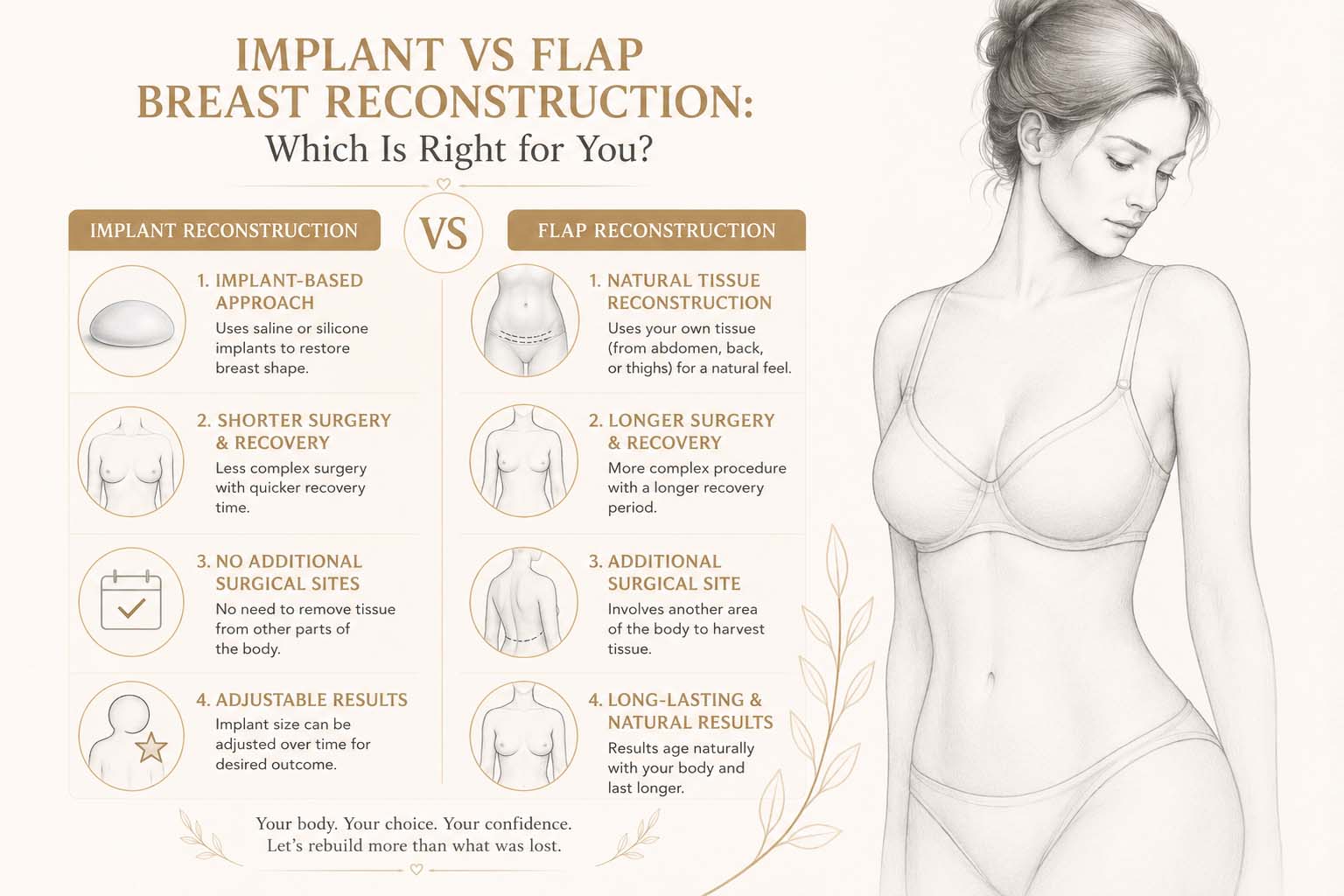
Implant or Your Own Tissue? Making Sense of Your Breast Reconstruction Choices
Most women hear the words "breast reconstruction" for the first time in a room where they've just been told something far more frightening. It's a lot to take in. And then, somewhere in that same conversation or the next one, someone asks whether you'd prefer an implant or your own tissue — as though you're meant to have an opinion already.
You're not. Nobody walks in with an opinion on this.
So let's slow it down. This is a decision about how you want to spend the next few months of your life, what kind of recovery you can realistically manage, and what you want your body to feel like in ten years. Not just what looks good in a photograph.
The two roads, in plain language
Implant-based reconstruction uses a silicone or saline implant to rebuild the breast shape. Depending on your skin and the surgery you've had, this may happen in one stage, or in two — with a tissue expander placed first, gradually filled over several weeks, and then swapped for the permanent implant.
Autologous (flap) reconstruction uses your own tissue — most commonly skin, fat and blood vessels taken from the lower abdomen (a DIEP flap), and sometimes from the back, thigh or buttock. The tissue is moved to the chest and its blood vessels are reconnected under a microscope. It becomes a living part of you.
Both are good operations. Neither is universally better. The right answer depends entirely on you.
What each one actually asks of you
Here's the part that often gets lost: these two options don't just produce different results, they demand different things from your body and your calendar.
Implant surgery is shorter. Two to three hours in most cases, one surgical site, a shorter hospital stay, and you're generally back to light routine in three to four weeks. If you have a small child at home, a job you can't step away from for long, or you simply don't want a second scar somewhere else on your body, this matters enormously.
Flap surgery is a bigger undertaking. Six to ten hours in theatre, sometimes longer for both sides. You'll be in hospital for four to six days, and full recovery takes six to eight weeks because there's now a second healing site — usually your abdomen. The trade-off is that once you've healed, you've largely finished. There's no implant to replace later.
I say this to my patients often: implant reconstruction is easier at the start and asks more of you over time. Flap reconstruction is harder at the start and asks less of you afterwards.
How they feel, and how they age
An implant sits under muscle or under the skin. It has a consistent, slightly firmer feel, and it holds its shape regardless of what happens to your weight. Some women find that reassuring. Others describe it as feeling like something they're carrying rather than something that's theirs.
Flap tissue is your own fat and skin. It's warm, it moves the way breast tissue moves, and it softens over the first year. It also changes with you — if you lose or gain a significant amount of weight, the reconstructed breast changes too, which usually helps with symmetry.
Over time, implants may need attention. Capsular contracture — where scar tissue tightens around the implant — happens in a proportion of patients, more commonly in women who've had radiotherapy. Implants can also rupture or shift, and most women will need at least one revision procedure across their lifetime. Flap reconstruction, once settled, is generally a one-and-done result.
Where radiotherapy changes everything
If radiotherapy is part of your cancer treatment, this conversation shifts. Radiated skin becomes tighter, thinner and less forgiving. Implants placed under radiated tissue have noticeably higher rates of contracture, poor cosmetic outcome and, sometimes, loss of the implant altogether.
Autologous tissue brings its own fresh, non-radiated blood supply into the area. It tolerates radiation far better, and often improves the quality of the overlying skin.
This is why I don't finalise a reconstruction plan until I know the full oncology plan. If your radiotherapy status is still uncertain, we may place a tissue expander to hold the space and make the definitive decision once the picture is clear. That's not indecision — that's sequencing your care properly
Who tends to suit which
Some patterns hold true fairly consistently.
Implants often work well for women with smaller to medium breasts, those who are slim without enough abdominal tissue to spare, women having both breasts reconstructed who want a symmetrical result quickly, and anyone who needs to return to normal life fast.
Flap reconstruction often works well for women who've had or will have radiotherapy, those with enough abdominal tissue, women with larger or more ptotic breasts where an implant would struggle to match the other side, anyone who's had a previous implant complication, and women who simply want a permanent, natural result and are prepared for the longer recovery.
But these are tendencies, not rules. I've done beautiful implant reconstructions in women who "should" have had a flap, and vice versa — because the woman in front of me had clear priorities and we built the plan around them.
Things worth knowing before you decide
● Flap surgery isn't possible for everyone. Previous abdominal surgery, particularly a tummy tuck, may rule out a DIEP flap. Heavy smoking significantly raises the risk of flap failure. These need honest discussion.
● Symmetry usually needs a second, smaller procedure. With either option. This is normal and planned for, not a sign anything went wrong.
● Nipple reconstruction and tattooing come last, typically three to six months after the main reconstruction.
● Sensation returns slowly and incompletely with both methods, though nerve-preserving techniques are improving this.
A word about not deciding today
You are allowed to say "I need time." You are allowed to ask to see photographs of real results. You are allowed to bring your husband, your sister, your daughter to the consultation and let them ask the questions you can't find words for.
At my practice in Banjara Hills, Hyderabad, I usually see women at least twice before we book anything. The first visit is mostly listening. The second is when the decision tends to make itself, because by then you understand your own priorities better than any of us could have guessed for you.
Talk it through
If you're in Hyderabad and facing this decision, or supporting someone who is, a proper consultation is worth far more than weeks of internet reading. Bring your reports, bring your questions, bring someone you trust.
Dr. Divya Sai Narsingam Plastic & Reconstructive Surgeon Banjara Hills, Hyderabad
Frequently Asked Questions
Is flap reconstruction safer than implant reconstruction?
Neither is inherently safer. Flap surgery has a longer operating time and a second surgical site, so it carries higher immediate surgical risk. Implants carry more long-term risks, such as capsular contracture and the likelihood of revision surgery. Your overall health and treatment plan determine which risk profile suits you better.
Will my reconstructed breast look like my natural one? The goal is balance in clothing and a natural silhouette without it — not an exact replica. Flap reconstruction generally produces a more natural feel and drape. Implants can produce excellent shape, particularly in bilateral cases where both sides are matched.
How long after mastectomy can I have reconstruction? Reconstruction can be immediate, at the same time as the mastectomy, or delayed by months or even years. Delayed reconstruction is a completely valid choice and is often recommended when radiotherapy is planned.
Will my insurance cover breast reconstruction in India? Most health insurance policies in India cover breast reconstruction following cancer surgery, as it's classed as reconstructive rather than cosmetic. Coverage varies by policy — our team can help you check before you commit to a plan.
Can I switch from an implant to a flap later? Yes. Women who develop capsular contracture or aren't satisfied with an implant result can often be converted to autologous reconstruction later. The reverse is far less common.